

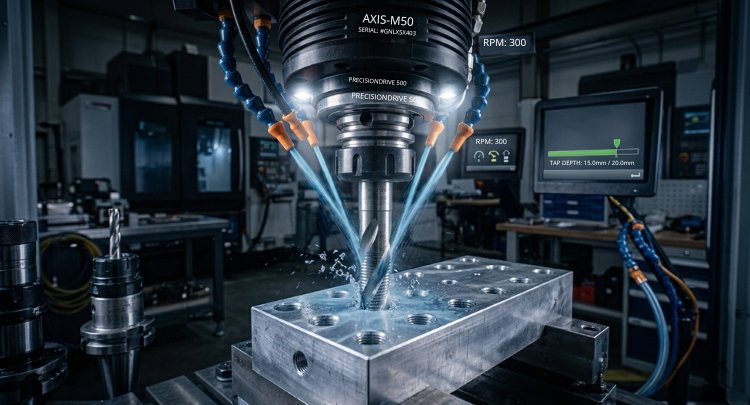
CNC Tapping: How Threaded Holes Are Machined in Industrial Parts
CNC tapping is a machining process used to create internal threads inside a drilled hole. These threads allow bolts, screws, and other fasteners to be securely installed into an industrial component.
The quality of a tapped hole depends on several factors, including the drilled hole size, thread specification, material, tapping tool, hole depth, and machining setup. For drawing-based manufacturing, these details should be clearly defined before custom machining production begins.
What Is CNC Tapping?
CNC tapping is an automated internal thread machining technique performed on computer-controlled equipment like CNC mills and lathes. Unlike manual thread cutting, the CNC tapping process synchronizes the machine spindle speed with the axial feed rate to match the exact pitch of the thread being cut. This precise movement yields consistent, high-accuracy tapped holes across high-volume production runs.
How Does the Tapping Process Work?
The tapping process executes through a synchronized sequence to turn a smooth bore into a functional threaded interface:
-
Tool Positioning: The CNC spindle aligns the tap directly over the center of the pre-drilled hole.
-
Synchronized Entry: The spindle rotates clockwise while feeding down along the $Z$-axis at a rate exactly equal to one thread pitch per revolution (rigid tapping).
-
Thread Generation: Cutting edges on the tap shear material away to form the helical thread geometry.
-
Spindle Reversal: Upon reaching the programmed thread depth, the spindle stops instantly and reverses counterclockwise at the same pitch rate to back out cleanly without damaging the newly formed threads.
Preparing a Hole Before Tapping
Successful thread creation relies heavily on accurate pre-tap preparation. Machining a tapped hole requires drilling a hole slightly smaller than the nominal thread diameter—known as the tap drill size. If the drill size is too small, the tap encounters excess cutting load and snaps; if it is too large, the resulting thread height will be insufficient, causing fasteners to strip under load. Furthermore, adding a slight chamfer or countersink at the hole entrance guides the tap lead-in smoothly and eliminates entry burrs.
Thread Size and Depth
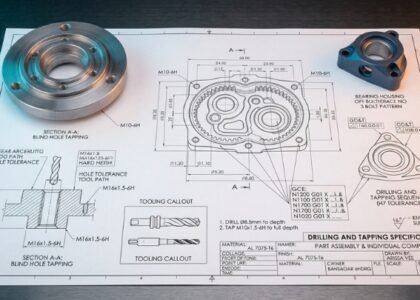
Thread callouts on technical engineering drawings dictate both pitch and engagement limits. Tapped holes are specified by standard systems such as Metric (e.g., M8 $\times$ 1.25) or Imperial Unified threads (e.g., 1/4″-20 UNC). Engineers must carefully define full thread depth—the distance over which complete, usable threads exist—separate from total drill depth. In most engineering components, a full thread depth equal to $1.5\times$ to $2\times$ the bolt diameter provides maximum mechanical holding strength.
Blind Hole Tapping
Machining threaded holes that do not pass through the entire workpiece presents specific operational challenges. During blind hole tapping, chips cannot fall out of the bottom and must be actively pulled out through the top of the hole. Additionally, room must be allowed at the base of the hole for chip accumulation and for the lead chamfer of the tap, ensuring full thread depth is achieved without the tap colliding with the solid bottom.
Through Hole Tapping
When a hole passes entirely through a component, through hole tapping offers a faster and more economical production route. Because the bottom end is completely open, chips are pushed forward ahead of the cutting tool and exit cleanly out the far side. This straightforward chip flow reduces tool stress, minimizes heat buildup, and allows for significantly higher machining speeds.
Choosing the Right Tapping Tool
Selecting the proper tool style is critical to executing reliable CNC machining operations across various materials:
-
Spiral Point Taps (Gun Taps): Designed with angular flutes at the tip that drive chips forward. Ideal for through hole tapping.
-
Spiral Flute Taps: Feature helical flutes (similar to a twist drill) that draw chips upward out of the hole entrance. Essential for blind hole tapping.
-
Forming Taps (Thread Roll Taps): Fluteless tools that cold-form threads by displace-deforming material rather than cutting chips. Excellent for ductile metals like aluminum, brass, and soft steels, producing zero chips and stronger threads.
Common Problems in Tapping
Despite automation, internal thread machining can face distinct mechanical issues if parameters are off:
-
Tap Breakage: Occurs when chips jam inside a blind hole, feed rates mismatch spindle speed, or coolant delivery is insufficient.
-
Cross-Threading / Distortion: Caused by misalignment between the tap centerline and the pre-drilled hole axis.
-
Oversized / Undersized Threads: Resulting from spindle runout, incorrect tap drill sizes, or tool wear.
-
Galled Threads: Common in sticky materials like stainless steel when proper cutting oil or lubricity additives are absent.
Inspection of Threaded Holes
To guarantee quality and drawing compliance, tapped holes undergo rigorous dimensional inspection:
-
Thread Plug Gauges (Go/No-Go): The “Go” gauge must thread smoothly into the hole to verify correct minimum pitch diameter, while the “No-Go” gauge must not enter beyond 2 turns, confirming the thread is not oversized.
-
Optical Comparators & CMM: Coordinate Measuring Machines inspect thread location, true position, perpendicularity, and pitch alignment on critical aerospace or automotive parts.
Applications of CNC Tapping
CNC tapping plays a foundational role in producing secure mechanical fasteners across diverse industries:
-
Automotive: Engine block assembly holes, cylinder heads, transmission cases, and suspension mounts.
-
Machinery & Equipment: Structural baseplates, motor mounting brackets, and hydraulic manifolds.
-
Electronics & Enclosures: Heat sink mountings, terminal busbars, and cabinet panel mountings.
-
Custom Engineering: Drawing-based machining for OEM components requiring custom bolt hole patterns and reliable joint assemblies.
Conclusion
From small mounting plates to heavy OEM assemblies, the CNC tapping process provides the structural precision required to turn simple drilled holes into reliable, load-bearing joints. By matching the right tool geometry, tap drill sizing, and chip evacuation method to the component material, custom machining partners produce high-quality tapped holes built to perform under demanding industrial conditions.



 Users Today : 0
 Users This Month : 1
 Total Users : 2