

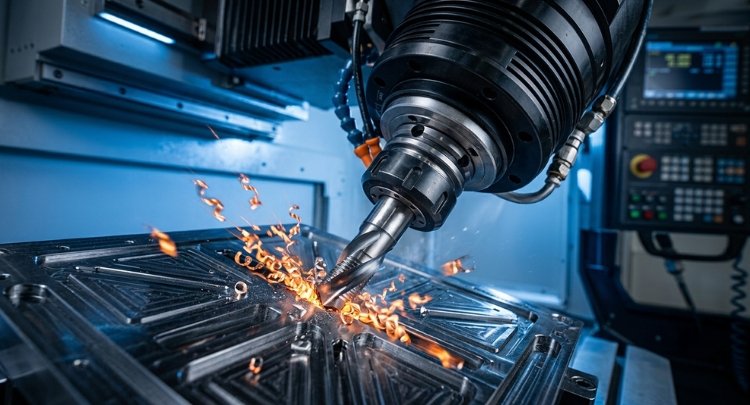
CNC Drilling and Tapping Services for Custom Industrial Components
CNC drilling and tapping are important machining operations used to create accurate holes and internal threads in industrial components. From machine brackets and plates to OEM parts and custom engineering components, correctly positioned holes and threads are essential for assembly. At J K Industrial Components, drilling and tapping work can be carried out according to engineering drawings, samples, and customer specifications. Requirements such as hole diameter, depth, location, thread details, and component quantity help determine the appropriate machining approach.
What Are CNC Drilling and Tapping Services?
CNC drilling and tapping services use Computer Numerical Control machinery to automate the creation of precise holes and internal threads in raw materials. CNC drilling uses a rotating drill bit to produce circular holes of exact diameters and depths, while CNC tapping follows by using a specialized thread-cutting tool to form internal helical threads for secure fastener attachment. Automating these processes ensures high repeatability, eliminates manual alignment errors, and significantly reduces overall manufacturing lead times.
Why Hole Accuracy Matters in Industrial Components
In custom engineering, even fractional misalignments can lead to complete assembly failure. Hole accuracy ensures proper alignment so mating parts fit seamlessly, distributes mechanical loads evenly to prevent stress cracking, and keeps threaded joints from loosening under continuous machine vibration. Furthermore, precise hole positioning guarantees part interchangeability, allowing replacement components to fit standard production lines without requiring manual reaming or on-site modification.
CNC Drilling for Through and Blind Holes
Different component designs require specific hole structures, primarily through holes and blind holes. Through holes pass entirely through the material thickness, where CNC control ensures clean entries and exits without excessive exit burrs or tool drift. Blind holes stop at a designated depth without breaking through the opposite side, relying on precise CNC depth controls along the $Z$-axis to maintain exact depth tolerances and protect thin backwalls.
CNC Tapping for Internal Threads
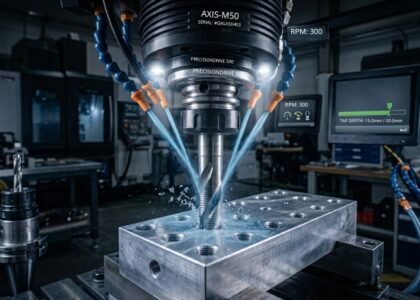
Tapping requires synchronized spindle rotation and feed rates to produce accurate, distortion-free internal threads. Modern CNC equipment utilizes rigid tapping to achieve uniform thread geometry across various specifications, including Metric, UNC/UNF, and Pipe threads. Depending on the hole structure, machinists select specialized tooling such as spiral point taps to push chips forward through open holes or spiral flute taps to pull chips upward out of blind holes to prevent tap breakage.
Drawing-Based Drilling and Tapping
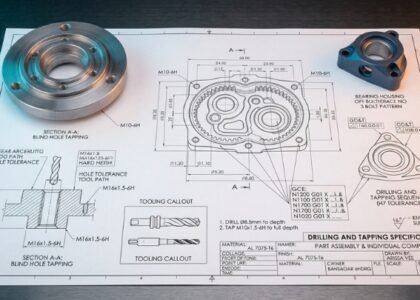
Custom machining relies on technical CAD files and 2D engineering drawings to convert digital parameters into physical components. CNC programs strictly adhere to Geometric Dimensioning and Tolerancing (GD&T) standards to maintain precise true positions, perpendicularity, and depth limits. This capability allows for complex bolt hole patterns, pitch circle diameters (PCDs), and multi-axis feature placements, while physical samples can also be reverse-engineered when formal drawings are absent.
Materials Commonly Used
Machining speeds, feeds, and coolant strategies are tailored directly to the workpiece material. Standard metals such as aluminum alloys (6061, 7075), mild steel, stainless steel (304, 316), brass, and copper offer high machinability, though stainless grades require controlled feeds to avoid work hardening. Engineering plastics like Delrin, Nylon, and PTFE require sharp tooling and high speeds to minimize thermal expansion, while tough alloys like Titanium and Inconel demand carbide bits and high-pressure coolant.
Industries That Require Drilled and Tapped Components
Precision hole placement and durable internal threading are foundational across numerous industrial sectors. Automotive and OEM manufacturers depend on them for engine blocks, transmission cases, and custom brackets, while heavy machinery builders use them for structural mounting plates and hydraulic manifolds. Additionally, the aerospace, electrical power distribution, and fluid power industries rely on accurately tapped holes for secure structural enclosures, terminal busbars, and leak-proof valve connections.
Factors to Consider Before Machining
Optimizing part quality while managing production costs requires evaluating several mechanical variables prior to machining. Material hardness directly dictates tool selection, cutting speeds, and chip clearance needs. Deep holes exceeding five times the tool diameter require specialized peck drilling cycles to clear debris, while thread depth should generally be kept between 1.5 to 2 times the bolt diameter to secure maximum joint strength without incurring unnecessary tool wear.
Why Choose a Professional Machining Partner?
Partnering with an experienced machining facility ensures every hole and thread satisfies tight manufacturing tolerances. Advanced multi-axis CNC machinery delivers fast cycle times alongside rigorous quality control using thread plug gauges and coordinate measuring machines (CMM). A qualified manufacturing partner also lowers costs through scrap reduction and provides complete end-to-end service, handling raw material procurement, precision machining, and post-process surface treatments like anodizing or heat treatment.
Conclusion
Whether producing high-volume production runs or specialized drawing-based custom parts, CNC drilling and tapping deliver the foundational accuracy required for robust industrial assemblies. At J K Industrial Components, commitment to exact drawing compliance, optimal material processing, and strict quality verification guarantees that every machined part performs reliably in demanding applications.

 Users Today : 0
 Users This Month : 1
 Total Users : 2